Understanding Infant Choking and Emergency Response
Choking in infants is a serious emergency that can quickly block the airway and stop breathing. Knowing what to do if a baby is choking or how to respond when an infant cannot breathe is critical in the first moments.
In Winnipeg, Manitoba, and across Canada, fast action—using appropriate infant first aid techniques and calling 911—can help restore breathing while waiting for paramedics.
First Aid & Workplace Relevance in Canada
Infant emergencies can happen at home, in daycare settings, or in public spaces across Winnipeg neighbourhoods like St. Vital, Transcona, and Downtown Winnipeg.
First aid and CPR training in Manitoba is especially important for:
-
Parents and caregivers
-
Daycare workers and teachers
-
Babysitters and family members
-
Community workers and volunteers
Courses that include infant CPR training in Winnipeg and first aid certification in Manitoba prepare people to act quickly and confidently in real-life situations.
Real-Life Scenario: Saskatoon Man Saves a Choking Infant
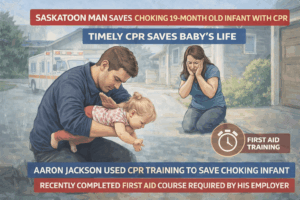 In Saskatoon, Aaron Jackson was driving along Arlington Avenue on his way to a grocery store when someone urgently flagged him down.
In a nearby driveway, a distressed woman was holding a 19-month-old child who was choking and struggling to breathe.
Recognizing the emergency, Jackson immediately stopped to help.
Just one month earlier, he had completed a two-day first aid course required by his employer. That training quickly came into focus as he assessed the situation and began providing aid.
Using techniques appropriate for infants and toddlers, he helped clear the airway and supported the child’s breathing. His actions allowed the child to begin breathing again.
He stayed with the child, continuing to monitor and stabilize her until paramedics arrived.
Jackson later shared that he simply responded to someone in need—and that anyone with training would have done the same. His quick thinking and recent training made a critical difference in the outcome.
Signs and Warning Signs of Choking in Infants
An infant who is choking may show:
-
Inability to cry or make sounds
-
Difficulty breathing or noisy breathing
-
Bluish lips or skin (late sign)
-
Weak or ineffective coughing
-
Becoming unresponsive if the airway remains blocked
Immediate recognition is key to responding effectively.
Causes and Risk Factors
Common causes of choking in infants include:
-
Small food items (grapes, nuts, hard foods)
-
Small objects or toys
-
Lack of supervision during feeding or play
Infants are at higher risk because of their small airways and tendency to explore objects with their mouths.
First Aid Response: What to Do
Based on standard first aid training practices in Canada, the recommended response includes:
-
Call 911 immediately if the infant cannot breathe
-
Provide cycles of back blows and chest thrusts:
-
Support the infant properly
-
Deliver firm back blows between the shoulder blades
-
Follow with chest thrusts if needed
-
-
Check if the airway clears
-
Begin CPR if the infant becomes unresponsive
-
Continue until help arrives
These techniques are commonly taught in certified infant CPR and first aid courses across Canada.
Prevention and Workplace Safety Considerations
In Winnipeg and across Manitoba, prevention strategies include:
-
Supervising infants during meals and play
-
Avoiding small or high-risk foods
-
Keeping small objects out of reach
-
Ensuring caregivers are trained in infant first aid
-
Including infant emergency response in childcare safety plans
Prepared caregivers and environments can significantly reduce risk.
Frequently Asked Questions
What should you do if a baby is choking and cannot breathe?
Call 911 immediately and begin infant choking first aid, including back blows and chest thrusts. If the infant becomes unresponsive, start CPR. Acting quickly is critical in restoring airflow.
Can CPR help if a choking infant becomes unresponsive?
Yes, CPR can help circulate oxygen and may assist in dislodging the blockage. It is commonly taught as part of infant first aid training in Canada.
Is infant CPR different from adult CPR?
Yes, infant CPR uses gentler techniques and different hand positioning. Proper training helps ensure the correct method is used for infants and young children.
How can choking in infants be prevented?
Supervision during feeding and play is key. Avoid giving small, hard foods and keep small objects out of reach. Education for caregivers also plays an important role.
Who should learn infant CPR?
Parents, grandparents, childcare workers, and anyone caring for infants should consider training. In emergencies, caregivers are often the first to respond.
About The Author

Mark Kascha
Certified First Aid Instructor Trainer with 30+ years of real-world experience, including lifeguarding, workplace emergency response, and first aid program development across Canada. Has worked with WorkSafeBC, WSIB, and Manitoba Health.
👉 [View full credentials]🔗 View LinkedIn Profile
Last reviewed: March 2026