Understanding Drowning and Safe Rescue Response
Drowning emergencies can escalate quickly, especially when someone enters the water to help without proper training. Knowing what to do if someone falls into a pool or how to respond safely when a person is drowning is critical—not only for the victim, but also for the rescuer.
In Winnipeg, Manitoba, and across Canada, water safety education emphasizes both rescue safety and CPR response to reduce the risk of multiple victims.
First Aid & Workplace Relevance in Canada
Water-related incidents can occur in apartment pools, lakes, and recreational facilities across Winnipeg neighbourhoods like Downtown Winnipeg, St. Vital, and Transcona.
Training is especially important for:
-
Parents and caregivers
-
Property managers and maintenance staff
-
Camp leaders and recreation workers
-
Teachers and community volunteers
Programs such as CPR training Winnipeg, first aid certification Manitoba, and water safety training Canada teach both rescue awareness and emergency response.
Real-Life Scenario: Grandmother and Toddler Drown in Surrey Pool
 In Surrey, a tragic drowning incident claimed the lives of a 51-year-old grandmother, Warina Nissan, and her 1-year-old grandson, Ivan Yousif.
According to reports, the toddler fell into a residential pool located in the 10500-block of 152nd Street. Seeing this, the grandmother—who was believed to be a non-swimmer—entered the water in an attempt to rescue him.
Both individuals were later found unconscious in the pool by children who had come onto the deck to retrieve a soccer ball. The children pulled them from the water and alerted others.
Emergency responders, including paramedics and fire crews, arrived shortly after and began resuscitation efforts. The child was transported to a healthcare facility but was later pronounced dead. The grandmother was taken to Royal Columbian Hospital in critical condition and later died from her injuries.
Authorities confirmed that the incident was accidental, with no signs of foul play or contributing factors such as drugs or alcohol.
This tragedy highlights a critical safety issue: untrained rescue attempts can sometimes lead to multiple victims.
A Critical Safety Concept: The Ladder Approach to Water Rescue
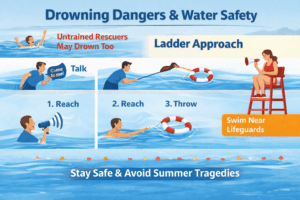
One of the most important principles taught in water safety is to avoid direct entry into the water whenever possible.
This is often referred to as the “ladder approach”:
-
Talk – Encourage the person to reach safety if possible
-
Reach – Use a hand, pole, or object from a safe position
-
Throw – Toss a flotation device or object they can hold
-
Go (with training only) – Enter the water only if trained and equipped
Untrained rescuers entering the water can:
-
Be pulled under by a panicked victim
-
Become exhausted quickly
-
Be unable to stay afloat while assisting another person
This is why many drowning incidents tragically involve more than one victim.
Symptoms and Warning Signs of Drowning
Drowning is often silent. Watch for:
-
Head low in the water or barely above surface
-
Gasping or struggling to breathe
-
Vertical body position with little movement
-
Sudden disappearance underwater
-
Unresponsiveness after rescue
Early recognition allows faster and safer intervention.
Causes and Risk Factors
Common contributing factors include:
-
Lack of swimming ability
-
Unsupervised access to pools
-
Panic during unexpected immersion
-
Attempting rescue without training
-
Absence of barriers or pool safety measures
Young children and non-swimmers are at especially high risk.
First Aid Response: What to Do
Based on standard first aid training practices in Canada:
-
Call 911 immediately
-
Ensure your own safety before attempting rescue
-
Use reach or throw methods instead of entering the water
-
Remove the person from the water if safe
-
Check breathing and responsiveness
-
Begin CPR if unresponsive and not breathing normally
-
Continue until emergency services arrive
These steps are commonly taught in certified CPR and water safety courses across Canada.
Prevention and Workplace Safety Considerations
In Winnipeg and across Manitoba, especially during the summer months, water safety should be a priority:
-
Always supervise children near water
-
Install proper barriers around pools
-
Choose swimming areas with lifeguards on duty
-
Avoid swimming alone
-
Encourage swimming lessons and water safety education
-
Train staff and families in CPR and safe rescue techniques
Swimming in supervised areas significantly reduces risk and improves emergency response times.
Frequently Asked Questions
What is the safest way to help a drowning person?
The safest method is to stay out of the water and use reach or throw techniques. Entering the water without training can put the rescuer at risk. This approach is commonly taught in water safety training across Canada.
Why do some rescuers drown during rescue attempts?
Panicked individuals may unintentionally pull rescuers underwater. Without proper training and equipment, rescuers can quickly become overwhelmed, leading to multiple victims.
Should you always perform CPR after a drowning rescue?
If the person is unresponsive and not breathing normally, CPR should be started immediately. Early action can help improve outcomes while waiting for emergency responders.
Is it safer to swim in areas with lifeguards?
Yes, lifeguards are trained to recognize distress early and respond quickly. Swimming in supervised areas is strongly recommended, especially for families and children.
How can drowning incidents be prevented at home?
Install barriers, supervise children closely, and ensure caregivers are trained in CPR and water safety. Prevention is the most effective way to reduce risk.
Educational Note
This article is for general awareness and reflects techniques commonly taught in certified first aid and CPR training across Canada. Safe rescue practices are an essential part of emergency preparedness.
About The Author

Mark Kascha
Certified First Aid Instructor Trainer with 30+ years of real-world experience, including lifeguarding, workplace emergency response, and first aid program development across Canada. Has worked with WorkSafeBC, WSIB, and Manitoba Health.
👉 [View full credentials]🔗 View LinkedIn Profile
Last reviewed: March 2026