Understanding Cardiac Arrest and AED Use
Sudden cardiac arrest can happen without warning, even during physical activity. Knowing what to do if someone collapses and stops breathing or how to respond using CPR and an AED can significantly improve survival.
In Winnipeg, Manitoba, and across Canada, access to AEDs in public places like arenas, schools, and workplaces plays a critical role in emergency response.
First Aid & Workplace Relevance in Canada
Cardiac emergencies can occur in gyms, hockey rinks, and workplaces across Winnipeg neighbourhoods such as St. Vital, Transcona, and Downtown Winnipeg.
Training is important for:
- Coaches and athletes
- Workplace staff and supervisors
- Teachers and recreation staff
- Community members and families
Programs such as CPR training Winnipeg, AED training Winnipeg, and first aid certification Manitoba prepare individuals to respond confidently.
Real-Life Scenario: Hockey Player Saved by AED in Abbotsford
 During a hockey game in Abbotsford, player Lindsay Hickmott suddenly collapsed on the ice.
Teammate Ed Griffioen noticed Hickmott struggling to stay upright before going down. When teammates reached him, he was having difficulty breathing and was unresponsive.
They quickly moved him off the ice and began CPR while another teammate retrieved an AED from the arena.
The AED analyzed his condition and delivered a shock. CPR continued as trained firefighters—already on site and nearby—arrived to assist. A second AED was applied, and another shock was delivered, helping restore a pulse.
Paramedics then transported Hickmott to a healthcare facility.
This incident highlights how rapid CPR and AED use together can make a life-saving difference.
What Is an AED and How Does It Help?
An Automated External Defibrillator (AED) is a portable device designed to help during cardiac arrest.
How It Works
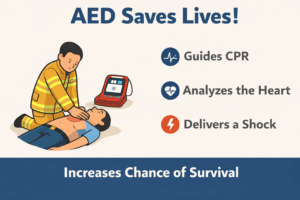
- The AED analyzes the heart’s rhythm automatically
- It determines if a shock is needed
- It delivers a controlled electrical shock to help restore a normal rhythm
Safety Feature
- An AED will not deliver a shock if it is not needed
- It will not shock a person with a normal pulse or rhythm
How an AED Guides You
AEDs are designed for public use and provide clear instructions:
- Voice prompts guide each step
- Tells you when to apply pads
- Instructs when to stand clear
- Advises when to resume CPR
Many AEDs also provide a rhythm or beat cue to help maintain proper compression timing.
Effectiveness of AED Use
AEDs are a critical part of the “chain of survival”:
- Early CPR helps maintain blood flow
- Early AED use can restore a normal heart rhythm
- Combined use significantly improves survival chances
AEDs are commonly found in public places across Canada because of their proven effectiveness.
Symptoms and Warning Signs of Cardiac Arrest
Watch for:
- Sudden collapse
- Unresponsiveness
- No normal breathing
- Gasping or irregular breathing
Immediate action is required.
First Aid Response: What to Do
Based on standard first aid training practices in Canada:
- Call 911 immediately
- Check responsiveness and breathing
- Begin CPR if not breathing normally
- Send someone to get an AED
- Turn on the AED and follow voice prompts
- Continue CPR as instructed
These steps are commonly taught in CPR and AED training courses across Canada.
Prevention and Workplace Safety Considerations
In Winnipeg and across Manitoba, safety can be improved by:
- Installing AEDs in public and workplace settings
- Training staff and community members
- Promoting awareness of cardiac arrest signs
- Ensuring quick access to emergency equipment
Prepared environments improve outcomes during emergencies.
Frequently Asked Questions
What should you do if someone collapses suddenly?
Call 911 immediately, check breathing, and begin CPR if needed. Use an AED as soon as it is available.
Can an AED be used by someone without medical training?
Yes, AEDs are designed for public use and provide step-by-step voice instructions to guide users.
Will an AED shock someone who doesn’t need it?
No, the device analyzes the heart rhythm and only delivers a shock if it is required.
How does an AED help during CPR?
It provides instructions and may give timing cues to help maintain effective chest compressions.
Why is early AED use important?
Using an AED quickly, along with CPR, increases the chances of survival during cardiac arrest.
Educational Note
This article is for general awareness and reflects techniques commonly taught in certified CPR and AED training across Canada. Early action and access to AEDs are key components of emergency response.
About The Author

Mark Kascha
Certified First Aid Instructor Trainer with 30+ years of real-world experience, including lifeguarding, workplace emergency response, and first aid program development across Canada. Has worked with WorkSafeBC, WSIB, and Manitoba Health.
👉 [View full credentials]🔗 View LinkedIn Profile
Last reviewed: March 2026