Understanding Cardiac Emergencies and AED Response
Sudden medical distress at border crossings, workplaces, or public areas can quickly become life-threatening. Knowing what to do if someone collapses and is gasping or not breathing normally or how to respond using CPR and an AED is critical.
In Winnipeg, Manitoba, and across Canada, fast action by bystanders—calling 911, starting CPR, and using an AED—can significantly improve survival.
First Aid & Workplace Relevance in Canada
 Cardiac emergencies can happen anywhere, including travel checkpoints, offices, and public facilities across Winnipeg neighbourhoods like Downtown, St. Vital, and Transcona.
Training is important for:
- Border and security personnel
- Workplace employees and supervisors
- Travelers and drivers
- Community members and families
Programs such as CPR training Winnipeg, AED training Winnipeg, and first aid certification Manitoba prepare individuals to respond effectively.
Real-Life Scenario: Life Saved at Huntingdon Border Crossing
At the Huntingdon Border Crossing, a 56-year-old man from Kamloops collapsed during a routine screening while traveling with his wife.
As they prepared to cross into Sumas for a winter trip, the man suddenly fell to the ground and began gasping.
Officers including Nicholas Sowell, Douglas Stuit, and Randy Mulanax immediately began CPR and called 911.
They continued life-saving efforts alongside a responding police officer. An AED was retrieved and used multiple times before paramedics arrived.
The man was transported to a healthcare facility, and the rapid response by trained personnel helped save his life.
Symptoms and Warning Signs of Cardiac Arrest
Watch for:
- Sudden collapse
- Unresponsiveness
- Gasping or abnormal breathing
- No normal breathing
Immediate action is required.
First Aid Response: What to Do
Based on standard first aid training practices in Canada:
- Call 911 immediately
- Check responsiveness and breathing
- Begin CPR if not breathing normally
- Send someone to get an AED
- Turn on the AED and follow prompts
- Continue CPR until help arrives
Compression-Only CPR for Lay Rescuers
For untrained or hesitant rescuers:
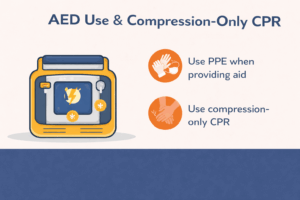
- Use hands-only CPR (compression-only)
- Push hard and fast in the center of the chest
- Do not delay care
This approach is commonly taught in CPR training and helps simplify response in emergencies.
AED Use for Different Ages
AED use varies slightly depending on the person’s age:
Adults
- Standard AED pads placed on the chest
- Full-energy shocks delivered if needed
Children
- Pediatric pads may be used if available
- Pads are placed similarly but adjusted for size
Infants
- Pediatric settings or pads used when available
- Pad placement may be adjusted (front and back)
AEDs provide instructions to guide proper use in each situation.
AED Pad Placement
Proper placement is important:
- One pad on the upper chest
- One pad on the lower side of the chest
For smaller individuals:
- Pads may be placed front and back if needed
AED diagrams and voice prompts guide correct placement.
Personal Protective Equipment (PPE)
When responding:
- Use gloves if available
- Avoid direct contact with bodily fluids
- Use barriers if possible
Personal safety is an important part of emergency care.
Effectiveness of AED Use
AEDs play a key role in survival:
- Analyze heart rhythm automatically
- Deliver shocks only when needed
- Guide rescuers step-by-step
- Improve survival when used early with CPR
AEDs are widely used across Canada due to their effectiveness.
Prevention and Workplace Safety Considerations
In Winnipeg and across Manitoba, safety can be improved by:
- Installing AEDs in public spaces
- Training staff and community members
- Promoting awareness of cardiac arrest signs
- Ensuring quick access to emergency equipment
Prepared environments save lives.
Frequently Asked Questions
What should you do if someone collapses and is gasping?
Call 911 immediately and begin CPR. Gasping is not normal breathing and requires emergency response.
Can untrained people use an AED?
Yes, AEDs are designed for public use and provide clear voice instructions to guide rescuers.
Is hands-only CPR effective?
Compression-only CPR can help maintain blood flow and is recommended for untrained bystanders.
Do AED pads differ for children and adults?
Yes, pediatric pads are designed for smaller bodies, but AEDs can still guide use if standard pads are used.
Why is PPE important during first aid?
PPE helps protect rescuers from exposure while providing care.
Educational Note
This article is for general awareness and reflects techniques commonly taught in certified CPR and AED training across Canada. Early action and proper use of equipment are critical in emergencies.
About The Author

Mark Kascha
Certified First Aid Instructor Trainer with 30+ years of real-world experience, including lifeguarding, workplace emergency response, and first aid program development across Canada. Has worked with WorkSafeBC, WSIB, and Manitoba Health.
👉 [View full credentials]🔗 View LinkedIn Profile
Last reviewed: March 2026