Understanding Cardiac Arrest and Shockable Arrhythmias
Sudden cardiac arrest occurs when the heart stops pumping effectively due to an abnormal rhythm. Knowing what to do if someone collapses suddenly or how to respond when a person is not breathing and has no pulse is critical.
In Winnipeg, Manitoba, and across Canada, rapid response using CPR and an AED can significantly increase survival—especially when the cause is a shockable arrhythmia.
First Aid & Workplace Relevance in Canada
Cardiac emergencies can happen in gyms, workplaces, and public facilities across Winnipeg neighbourhoods like Downtown, St. Vital, and Transcona.
Training is important for:
- Fitness staff and gym users
- Workplace employees and supervisors
- Coaches and recreation staff
- Community members and families
Programs such as CPR training Winnipeg, AED training Winnipeg, and first aid certification Manitoba prepare individuals to respond effectively.
Real-Life Scenario: AED Saves Man at Abbotsford Recreation Centre
 At the Abbotsford Recreation Centre, a middle-aged man collapsed after finishing a workout on a treadmill.
He had just joined his wife on the track when he suddenly went down.
Multiple trained individuals quickly responded, including off-duty paramedic Jim Earle and auxiliary firefighter Brian Wiens. Two emergency room nurses and a corrections officer also assisted.
They immediately began CPR while retrieving a Lifepak defibrillator on site.
According to facility manager Jennifer Thornton, the presence of trained responders and equipment made a critical difference.
The AED analyzed the man’s heart rhythm and delivered a shock. A single shock restored a pulse, and by the time paramedics arrived, he was conscious and speaking.
This case highlights how early CPR and AED use can reverse certain deadly arrhythmias.
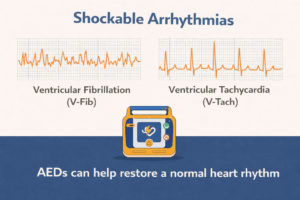
What Are Shockable Arrhythmias?
Some types of cardiac arrest are caused by rhythms that can be corrected with a defibrillator:
Ventricular Fibrillation (VF)
- Chaotic, irregular heart rhythm
- Heart cannot pump blood effectively
Ventricular Tachycardia (VT)
- Very fast heart rhythm
- May prevent proper circulation
These are called shockable rhythms because an AED can help restore a normal rhythm.
How an AED Helps in These Cases
An AED is designed to:
- Analyze the heart rhythm automatically
- Identify if the rhythm is shockable (VF or VT)
- Deliver a controlled electrical shock to reset the heart
Key Benefits
- Works within seconds to assess rhythm
- Provides voice instructions for rescuers
- Helps guide CPR timing
- Only shocks when appropriate
An AED will not deliver a shock if:
- A normal rhythm is present
- There is no shockable rhythm detected
This makes it safe and effective for public use.
Effectiveness of AED Use
When used quickly:
- AEDs can significantly improve survival rates
- Early CPR keeps blood flowing
- Early defibrillation can restore a viable heart rhythm
This combination is a core part of emergency response training across Canada.
Symptoms and Warning Signs
Signs of cardiac arrest include:
- Sudden collapse
- Unresponsiveness
- No normal breathing
- Gasping or irregular breathing
Immediate action is required.
First Aid Response: What to Do
Based on standard first aid training practices in Canada:
- Call 911 immediately
- Check responsiveness and breathing
- Begin CPR if not breathing normally
- Send someone to get an AED
- Turn on the AED and follow prompts
- Continue CPR as instructed
These steps are commonly taught in CPR and AED courses across Canada.
Prevention and Workplace Safety Considerations
In Winnipeg and across Manitoba, cardiac emergency preparedness can be improved by:
- Installing AEDs in gyms and public facilities
- Training staff and community members
- Promoting awareness of cardiac arrest symptoms
- Ensuring quick access to emergency equipment
Prepared environments save lives.
Frequently Asked Questions
What is a shockable arrhythmia?
A shockable arrhythmia is an abnormal heart rhythm, such as ventricular fibrillation or ventricular tachycardia, that can be treated using a defibrillator.
How does an AED know when to deliver a shock?
The AED analyzes the heart rhythm automatically and only delivers a shock if a shockable rhythm is detected.
Can an AED be used by someone without training?
Yes, AEDs provide step-by-step voice instructions and are designed for public use in emergencies.
Why is early defibrillation important?
Delivering a shock quickly can help restore a normal heart rhythm and improve survival chances.
Do you still need CPR if an AED is available?
Yes, CPR should be continued alongside AED use as instructed by the device.
Educational Note
This article is for general awareness and reflects techniques commonly taught in certified CPR and AED training across Canada. Early recognition and rapid response are key to improving survival outcomes.
About The Author

Mark Kascha
Certified First Aid Instructor Trainer with 30+ years of real-world experience, including lifeguarding, workplace emergency response, and first aid program development across Canada. Has worked with WorkSafeBC, WSIB, and Manitoba Health.
👉 [View full credentials]🔗 View LinkedIn Profile
Last reviewed: March 2026