More details about this life-saving incident can be found in the original CBC News article here:
 It’s emotional to say the least Toronto man meets paramedics who saved his life
A Normal Game Turned Into a Medical Emergency
On November 23, Turco was playing pickup basketball at Neil McNeil High School, where he also works as a physical education teacher. He had already been on the court for more than an hour when a friend asked if he wanted to play one more game.
“I said, ‘Yeah sure, I’m good,’” Turco recalled.
That was the last thing he remembers.
Moments later, after scoring a basket and backpedaling toward the defensive end of the court, Turco suddenly collapsed. His teammate, Gerald Rozario, said there were no warning signs.
“I remember from my peripheral him just falling straight back,” Rozario said. “I remember his head bouncing off the ground.”
Immediate CPR and AED Use Made the Difference
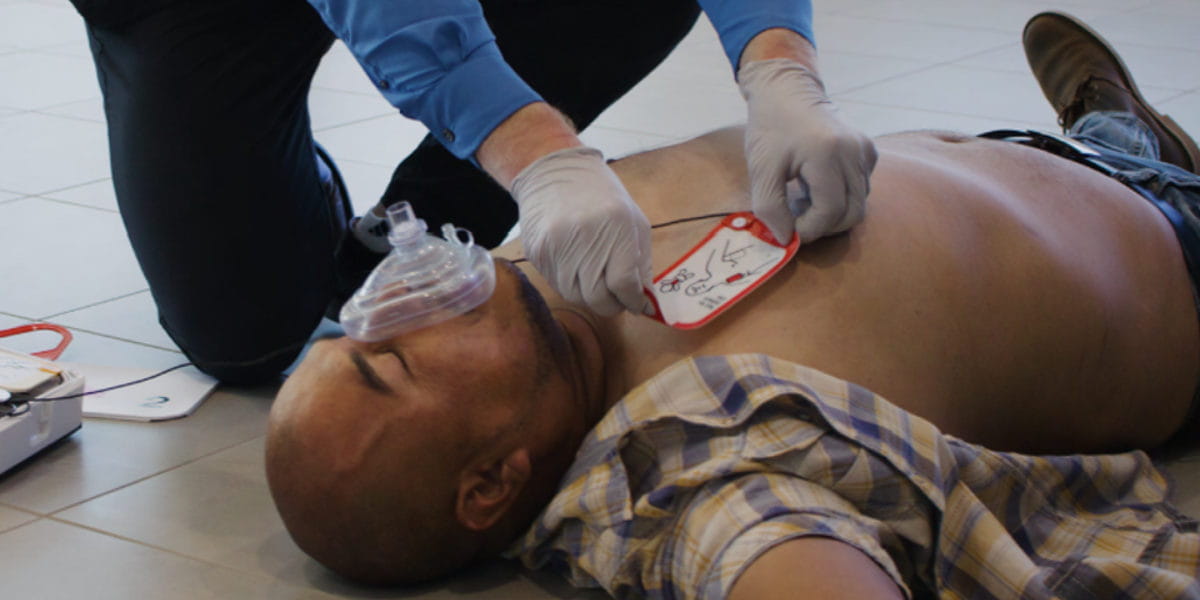
Without hesitation, Rozario shouted for someone to call 911 and asked another player to retrieve the school’s defibrillator. Along with two others, he immediately began CPR.
Although Rozario had completed CPR training before, this was the first time he had ever needed to use Those skills in a real-life emergency.
When Turco did not regain a pulse, they took the next critical step.
“We cut his shirt and used the defibrillator,” Rozario said.
This rapid response is exactly what cardiac arrest guidelines recommend. Early CPR keeps oxygen flowing to the brain, while AEDs can help restore a normal heart rhythm. Survival rates can double when CPR and an AED are used within the first few minutes.
This is why accessible, hands-on training — like the CPR and AED courses offered by Winnipeg First Aid — is so important. These skills empower everyday people to step in and save lives before emergency responders arrive.
Paramedics Arrive to a Rare Sight
Emergency crews arrived shortly after. Paramedic Steven Deans was the first to reach Turco.
“I could see his chest moving up and down from across the gym floor,” Deans said. “That’s an excellent sign.”
Another paramedic, Chris Miller, said the scene was already under control — something he rarely encounters.
“This is the first experience for me seeing bystanders come together like that,” Miller said.
By the time Turco was placed in the ambulance, he was conscious, talking, and even joking.
“He said, ‘Aw man, my wife’s going to kill me — she hates when I play basketball,’” Deans recalled.
It turns out his wife wasn’t the one stopping him.
“Well, the cardiologist won’t let me play,” Turco said with a smile.
He hopes to return to the court once he’s medically cleared.
Why CPR Training Matters
John Turco’s survival wasn’t luck — it was preparation. Cardiac arrest can happen without warning, even to active and healthy individuals. When it does, the people nearby become the first responders.
Knowing CPR and how to use an AED gives you the confidence to act decisively when it matters most.
Learn How to Help
You don’t need to be a paramedic to save a life. Proper training prepares you to respond calmly and effectively during emergencies.
For more information about CPR and first aid, visit these trusted resources:
About The Author
Mark Kascha
Certified First Aid Instructor Trainer with 30+ years of real-world experience, including lifeguarding, workplace emergency response, and first aid program development across Canada. Has worked with WorkSafeBC, WSIB, and Manitoba Health.
👉 [View full credentials]🔗 View LinkedIn Profile
Last reviewed: March 2026
Serving Winnipeg and south Manitoba with the cheapest priced, highest quality first aid training, CPR and food safety courses since 2012 with a commitment to providing the best classes to Canadians.