Understanding Sudden Medical Emergencies
Sudden medical distress can happen without warning and may involve breathing problems, heart conditions, or cardiac arrest. Knowing what to do if someone collapses and is gasping for breath or how to respond when a person becomes unresponsive is critical.
In Winnipeg, Manitoba, and across Canada, rapid recognition, CPR, and AED use can significantly improve survival.
First Aid & Workplace Relevance in Canada
Medical emergencies can occur anywhere—border crossings, workplaces, public buildings, and vehicles across Winnipeg neighbourhoods such as Downtown, St. Vital, and Transcona.
Training is important for:
- Border and security personnel
- Workplace employees and supervisors
- Drivers and travelers
- General public and families
Programs such as CPR training Winnipeg, AED training Winnipeg, and first aid certification Manitoba prepare individuals to respond quickly and confidently.
Real-Life Scenario: Life Saved at Huntingdon Border Crossing
 At the Huntingdon Border Crossing, a 56-year-old man from Kamloops experienced sudden medical distress while crossing into the U.S. near Sumas.
During a routine stop, he collapsed and began gasping for air.
Officers including Nicholas Sowell, Douglas Stuit, and Randy Mulanax immediately began CPR and called 911.
An AED was retrieved and used multiple times before paramedics arrived. The coordinated response helped stabilize the man, who was transported to hospital for further care.
This incident highlights how fast action and trained responders can make a life-saving difference.
What Could Cause Sudden Medical Distress?
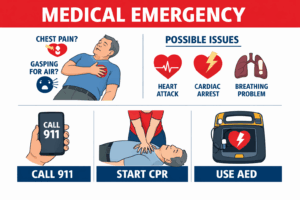
A person collapsing and gasping for breath may be experiencing:
Cardiac Arrest
- Heart stops beating effectively
- Requires immediate CPR and AED
Heart Attack
- Blocked blood flow to the heart
- May lead to cardiac arrest
Breathing Emergencies
- Airway blockage or respiratory distress
- May present as gasping
Severe Medical Conditions
- Stroke
- Low oxygen levels
- Underlying heart rhythm problems (arrhythmias)
These conditions can appear similar and require rapid assessment.
Recognizing Gasping: A Critical Warning Sign
Gasping or irregular breathing is not normal breathing.
- Often occurs in cardiac arrest
- May be mistaken for breathing
- Requires immediate CPR
Recognizing this sign is commonly taught in CPR courses across Canada.
First Aid Response: What to Do
Based on standard first aid training practices in Canada:
- Call 911 immediately
- Check responsiveness
- Check breathing (look for normal breathing, not gasping)
- Start CPR right away if unresponsive
- Send someone to get an AED
- Use the AED as soon as available
- Continue CPR until help arrives
The Role of CPR and AED
CPR
- Keeps blood circulating to vital organs
- Helps maintain oxygen delivery
AED
- Analyzes heart rhythm
- Delivers a shock if needed
- Provides voice prompts for rescuers
- Will not shock if it is not required
Using both together significantly improves survival chances.
Managing Different Possible Conditions
When the exact cause is unknown:
- Focus on basic life support (CPR and AED)
- Do not delay action trying to diagnose
- Monitor for changes in breathing or responsiveness
- Follow AED instructions carefully
These principles are emphasized in Canadian first aid training.
Prevention and Preparedness
In Winnipeg and across Manitoba, preparedness includes:
- Learning CPR and AED use
- Knowing locations of AEDs in public places
- Maintaining general health and regular check-ups
- Encouraging workplace emergency training
Prepared communities respond more effectively.
Frequently Asked Questions
What does gasping mean in an emergency?
Gasping is often a sign of cardiac arrest and should not be considered normal breathing.
Should CPR be started if someone is gasping?
Yes, if they are unresponsive and not breathing normally, CPR should begin immediately.
Why is an AED important?
An AED can restore a normal heart rhythm and significantly improve survival chances.
What if you’re not sure what caused the collapse?
Start CPR and use an AED if available—do not delay action.
Can bystanders really save a life?
Yes, early CPR and AED use by bystanders can make a critical difference.
Educational Note
This article is for general awareness and reflects techniques commonly taught in certified CPR and AED training across Canada. Early recognition and rapid action are essential in medical emergencies.
About The Author

Mark Kascha
Certified First Aid Instructor Trainer with 30+ years of real-world experience, including lifeguarding, workplace emergency response, and first aid program development across Canada. Has worked with WorkSafeBC, WSIB, and Manitoba Health.
👉 [View full credentials]🔗 View LinkedIn Profile
Last reviewed: March 2026