Understanding CPR Today: What to Do in an Emergency
Cardiopulmonary resuscitation (CPR) is a critical life-saving skill used when someone is not breathing or has no pulse. Knowing what to do if someone collapses and stops breathing or how to respond when CPR is needed after a traumatic incident can make a life-saving difference.
CPR techniques have evolved significantly over the years, which is why staying up to date with training is essential.
First Aid & Workplace Relevance in Winnipeg, Manitoba
 In Winnipeg, Manitoba, emergencies can happen in schools, sports fields, workplaces, and public areas like St. Vital, Transcona, and Downtown Winnipeg.
CPR training in Winnipeg and first aid certification in Manitoba are essential for:
- Coaches and sports staff
- Workplace safety officers
- Teachers and school personnel
- Parents and community members
These skills are taught in emergency response training across Canada, and regular recertification ensures responders are using the most current techniques.
Scenario: Quick Action at Youth Soccer Field
In Conception Bay South, Newfoundland and Labrador, two individuals were recognized for their life-saving efforts during a serious incident at a youth soccer event.
Gerry Stead, a safety specialist with 3M Canada, and Alana Langdon, a community health nurse, responded when an 11-year-old player was critically injured during a fall skills camp at the Topsail artificial turf soccer pitch.
They quickly assessed the situation and began first aid and CPR, providing immediate care while waiting for paramedics to arrive.
Their actions helped stabilize the young player, who later underwent multiple surgeries over the following months. Thanks to early intervention and continued care, the child eventually recovered and returned to playing soccer.
This incident highlights the importance of trained bystanders—something that applies equally to sports fields and schools across Winnipeg and Manitoba.
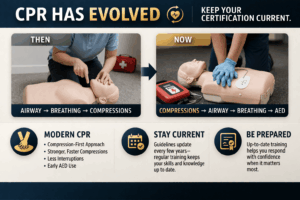
How CPR Has Changed Over the Years
CPR is not the same as it was decades ago. Updates are based on research and real-world outcomes.
Then (Older Methods)
- Focus on airway, breathing, then compressions (ABC approach)
- Longer pauses between steps
- Less emphasis on compression depth and speed
Now (Modern CPR)
- CAB approach: compressions first, then airway and breathing
- Strong focus on high-quality chest compressions
- Reduced interruptions during CPR
- Increased emphasis on AED use
These updates are commonly taught in current CPR certification courses in Canada.
Compression-Only vs Full CPR
Modern CPR also includes:
Compression-Only CPR
- Recommended for untrained bystanders in adult cardiac arrest
- Focuses on continuous chest compressions
CPR with Breaths
- Still emphasized for:
- Children
- Drowning victims
- Certain medical emergencies
Understanding when to use each method is part of updated training.
Why Keeping Your CPR Certification Current Matters
CPR guidelines are regularly updated based on new evidence. Staying certified ensures:
- You are using the most effective techniques
- You understand current compression depth and rate standards
- You are confident using an AED
- You can respond appropriately in different scenarios
In Winnipeg workplaces and schools, many certifications are recommended to be renewed every 1–3 years, depending on requirements.
Symptoms and Situations That May Require CPR
CPR may be needed if someone:
- Is unresponsive
- Is not breathing or only gasping
- Has no detectable pulse
- Collapses suddenly
Immediate action is critical.
First Aid Response: What to Do
Based on standard first aid training practices in Canada:
- Call emergency services immediately
- Check responsiveness and breathing
- Begin CPR (chest compressions first)
- Use an AED as soon as available
- Continue CPR until help arrives
Early CPR significantly improves outcomes.
Prevention and Workplace Safety Considerations
To improve emergency readiness in Winnipeg and across Manitoba:
- Keep CPR certifications up to date
- Ensure AEDs are accessible in workplaces and sports facilities
- Train staff regularly in CPR and AED use in Winnipeg
- Conduct emergency response drills
- Promote awareness in schools and community programs
Prepared individuals and environments save lives.
Frequently Asked Questions
How often should you renew your CPR certification in Canada?
Most certifications are valid for 1 to 3 years. Regular renewal ensures you are up to date with the latest techniques and guidelines.
Has CPR changed a lot over time?
Yes, CPR has evolved significantly. Modern approaches focus more on chest compressions, reduced interruptions, and early AED use.
Why is compression-first CPR important?
Starting with compressions helps circulate blood quickly, which is critical in cardiac arrest situations.
Do I still need to learn rescue breaths?
Yes, especially for children and drowning victims. Full CPR with breaths is still an important part of training.
Who should take CPR training in Winnipeg?
Anyone can benefit, including workers, parents, and coaches. CPR training prepares individuals to respond effectively in emergencies.
Educational Note
This article is for general awareness and reflects commonly taught CPR practices in Canada. Keeping skills current and acting quickly are key to effective emergency response.
About The Author

Mark Kascha
Certified First Aid Instructor Trainer with 30+ years of real-world experience, including lifeguarding, workplace emergency response, and first aid program development across Canada. Has worked with WorkSafeBC, WSIB, and Manitoba Health.
👉 [View full credentials]🔗 View LinkedIn Profile
Last reviewed: March 2026