Understanding AED Use in Cardiac Emergencies
An Automated External Defibrillator (AED) is a life-saving device used when someone is unresponsive and not breathing normally. Knowing what to do if someone collapses at work or how to respond using CPR and an AED can significantly improve survival.
AEDs are designed to be simple to use, but understanding their limitations and proper maintenance is just as important as knowing how to operate them.
First Aid & Workplace Relevance in Winnipeg, Manitoba
 In Winnipeg, Manitoba, AEDs are commonly found in workplaces, construction sites, recreation centres, and public buildings in areas like Downtown Winnipeg, Transcona, and St. Vital.
CPR training in Winnipeg, AED training in Canada, and first aid certification in Manitoba are essential for:
- Workplace emergency response teams
- Construction and industrial workers
- Office staff and supervisors
- Community organizations
These skills are widely taught in emergency response training across Canada, helping teams act quickly and effectively.
Scenario: Team Saves Colleague at Worksite
At the Hebron Gravity Base Structure site, a worker from Clarenville was saved thanks to the quick actions of a trained emergency response team.
Adrian Tarrant, along with Jamie Budden and Ashley Perham, responded to a call over the radio reporting an unconscious colleague.
When Tarrant and Perham arrived, Budden had already begun CPR. The team worked together seamlessly:
- CPR was continued without interruption
- An AED was applied and used
- Roles were shared to maintain consistent care
After delivering a second shock with the AED, the team was able to restore a pulse. The worker was then transported to a healthcare facility.
Their coordinated response and training were credited with saving the man’s life—highlighting the importance of teamwork and preparedness in Canadian workplaces, including those in Manitoba.
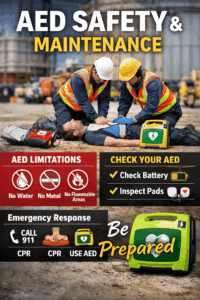
AED Limitations: When and Where to Use Caution
AEDs are highly effective, but certain conditions require awareness:
Water and Wet Environments
- AEDs should not be used in standing water
- Move the person to a dry area if possible
- Dry the chest quickly before applying pads
Metal Surfaces
- AEDs can be used on metal (e.g., construction sites), but:
- Ensure no one is touching the person during shock
- Avoid contact with conductive surfaces during use
Explosive or Flammable Environments
- Avoid using an AED near flammable gases or vapours
- Sparks from the device could pose a risk in rare cases
Movement or Vibration
- Excessive movement (e.g., in vehicles) can interfere with analysis
- Keep the person as still as possible during AED use
These considerations are commonly discussed in AED training courses across Canada.
Importance of AED Maintenance
An AED is only effective if it is ready to use.
Key Maintenance Checks
- Battery status: Ensure it is charged and within expiry
- Electrode pads: Check expiration dates and packaging integrity
- Self-test indicators: Many AEDs run automatic checks—monitor status lights or alerts
- Accessibility: Ensure the AED is easy to locate and not obstructed
Workplaces in Winnipeg and across Manitoba often assign responsibility for regular AED checks as part of safety programs.
Symptoms and Situations Requiring AED Use
An AED may be needed if a person:
- Is unresponsive
- Is not breathing or only gasping
- Has collapsed suddenly
AEDs are used alongside CPR to help restore a normal heart rhythm.
First Aid Response: What to Do
Based on standard first aid training practices in Canada:
- Call emergency services immediately
- Check responsiveness and breathing
- Begin CPR (chest compressions)
- Retrieve and apply an AED as soon as possible
- Follow AED voice prompts
- Continue CPR until help arrives
Early CPR and AED use are critical.
Prevention and Workplace Safety Considerations
To improve readiness in Winnipeg and across Manitoba:
- Install AEDs in accessible locations
- Train staff in CPR and AED use in Winnipeg
- Conduct regular equipment checks
- Develop emergency response plans
- Promote awareness and drills
Prepared teams save lives.
Frequently Asked Questions
Can you use an AED on a wet person?
The chest should be dry before applying AED pads. Avoid using the device in standing water and move the person if possible.
Is it safe to use an AED on metal surfaces?
Yes, but ensure no one is touching the person during shock delivery. Safety precautions must be followed.
How often should AEDs be checked?
Regular checks should be performed according to workplace protocols. This often includes monitoring battery life and pad expiration.
Why is AED maintenance important?
An AED must be ready to function during an emergency. Poor maintenance can result in device failure when it is needed most.
Who should take AED training in Winnipeg?
Workers, supervisors, and community members can all benefit. Training helps individuals respond effectively in emergencies.
Educational Note
This article is for general awareness and reflects commonly taught first aid and AED practices in Canada. Proper use, awareness of limitations, and regular maintenance are key to effective emergency response.
About The Author

Mark Kascha
Certified First Aid Instructor Trainer with 30+ years of real-world experience, including lifeguarding, workplace emergency response, and first aid program development across Canada. Has worked with WorkSafeBC, WSIB, and Manitoba Health.
👉 [View full credentials]🔗 View LinkedIn Profile
Last reviewed: March 2026