Understanding Sudden Collapse and Cardiac Emergencies
A sudden collapse during sports—such as hockey—can be a life-threatening emergency. Knowing what to do if someone collapses and stops breathing or how to respond when CPR and an AED are needed can save a life.
In many cases, this type of emergency may be linked to cardiac arrest, where the heart stops pumping effectively. Immediate CPR and early use of an AED (Automated External Defibrillator) are critical.
First Aid & Workplace Relevance in Winnipeg, Manitoba
In Winnipeg, Manitoba, hockey arenas, community rinks, and recreation centres in areas like St. Vital, Transcona, and Downtown Winnipeg host games and practices year-round.
CPR training in Winnipeg and first aid certification in Manitoba are essential for:
- Coaches and team staff
- Arena employees and volunteers
- Players and parents
- School sports programs
These skills are widely taught in emergency response training across Canada, helping people respond quickly in sports and workplace settings.
Scenario: Hockey Player Revived After Collapse
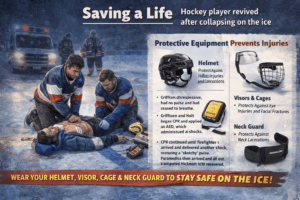 During a hockey game in Abbotsford, British Columbia, a player named Lindsay Hickmott experienced a sudden and life-threatening emergency on the ice.
Early in the first period, Hickmott was skating during his shift when teammates noticed something was wrong. He appeared unsteady, trying to support himself with his stick before suddenly collapsing.
Teammates, including Ed Griffioen and Kirk Holt, initially thought he may have tripped. However, when they reached him, it became clear the situation was serious—Hickmott was struggling to breathe, appeared disoriented, and said he felt sick.
Moments later, he became unresponsive. His eyes rolled back, and he stopped breathing and had no detectable pulse.
Timely Action on the Ice
Recognizing the emergency:
- Teammates quickly moved him off the ice
- CPR was started immediately
- Another teammate retrieved the arena’s AED
The AED analyzed his heart rhythm and delivered a shock. CPR continued as responders worked to restore circulation.
Firefighters arrived and took over care, applying another AED shock. This time, a weak pulse was restored. Paramedics then transported Hickmott to hospital.
Weeks later, he stood alongside his rescuers, able to recover and eventually return to skating—an outcome made possible by fast, coordinated action and proper training.
Hockey Safety Equipment and Injury Prevention
While this incident involved a cardiac emergency, hockey is also a sport where protective equipment plays a major role in preventing injuries.
Common Hockey Injuries
- Head injuries or concussion
- Facial injuries (cuts, fractures)
- Neck and throat injuries
- Dental injuries
- Shoulder and joint injuries
Importance of Protective Equipment
Helmets
- Help protect against head injuries and concussions
- Essential for all levels of play
- Reduce severity of impact during falls or collisions
Visors and Cages
- Protect the face from sticks, pucks, and collisions
- Reduce risk of eye injuries and facial fractures
- Commonly required in youth and amateur leagues
Neck Guards
- Provide protection to the throat and neck area
- Help reduce risk of serious cuts from skate blades
- Increasingly recommended in leagues across Canada
Wearing full protective equipment is a key part of hockey safety practices in Manitoba and across Canada.
Symptoms and Warning Signs of Cardiac Emergency
Watch for:
- Sudden collapse
- No breathing or abnormal breathing
- No pulse
- Unresponsiveness
- Seizure-like activity in some cases
Immediate action is required.
First Aid Response: What to Do
Based on standard first aid training practices in Canada:
- Call for help and activate emergency response
- Check breathing and responsiveness
- If not breathing, begin CPR (chest compressions)
- Retrieve and use an AED as soon as possible
- Follow AED prompts and continue CPR
- Continue until help arrives
Early CPR and AED use are critical in cardiac emergencies.
Prevention and Workplace Safety Considerations
To improve safety in Winnipeg arenas and Manitoba sports facilities:
- Ensure access to AEDs in all recreation centres
- Train staff and coaches in CPR and AED use in Winnipeg
- Encourage proper use of protective equipment
- Promote awareness of emergency procedures
- Conduct regular safety checks and drills
Prepared environments save lives.
Frequently Asked Questions
What should you do if someone collapses during a hockey game?
Call emergency services immediately and check for breathing. If the person is not breathing, begin CPR and use an AED as soon as it is available.
Why is an AED important in sports facilities?
An AED can help restore a normal heart rhythm during cardiac arrest. Early use significantly improves outcomes and is commonly taught in CPR courses across Canada.
What injuries can hockey equipment prevent?
Helmets, visors, cages, and neck guards help reduce the risk of head, facial, and throat injuries. They are essential for player safety.
Are neck guards necessary in hockey?
They are strongly recommended as they help protect against serious neck injuries, including cuts from skate blades.
Who should take CPR training in Winnipeg?
Coaches, players, parents, and staff can all benefit. Training prepares individuals to respond quickly in emergencies.
Educational Note
This article is for general awareness and reflects commonly taught first aid and safety practices in Canada. Quick CPR, AED use, and proper protective equipment all contribute to safer sports environments.
About The Author

Mark Kascha
Certified First Aid Instructor Trainer with 30+ years of real-world experience, including lifeguarding, workplace emergency response, and first aid program development across Canada. Has worked with WorkSafeBC, WSIB, and Manitoba Health.
👉 [View full credentials]🔗 View LinkedIn Profile
Last reviewed: March 2026