Understanding Cardiac Arrest and Immediate Response
Cardiac arrest occurs when the heart suddenly stops pumping effectively. Knowing what to do if someone collapses and stops breathing or how to respond when an AED is delayed or unavailable is critical.
A unique and important concept is that continuous, high-quality CPR can sustain life for extended periods—even when defibrillation is delayed.
First Aid & Workplace Relevance in Winnipeg, Manitoba
In Winnipeg, Manitoba, cardiac emergencies can happen anywhere—including workplaces, public events, and recreational spaces like Tinkertown, Downtown Winnipeg, and St. Boniface.
CPR training in Winnipeg and AED training in Winnipeg are essential for:
- Workplace teams and safety officers
- Event staff and public workers
- Families and community members
- Fitness and recreation staff
These skills are widely taught in emergency response training across Canada, emphasizing teamwork and sustained CPR.
Scenario: Firefighter Saved by Continuous CPR in Winnipeg
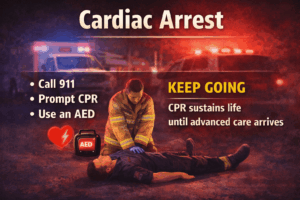 During a workplace barbecue at Tinkertown in Winnipeg, firefighter-paramedic Steve Sawatzky suddenly collapsed due to cardiac arrest.
- Colleagues immediately recognized the emergency
- The on-site AED had issues and could not be used right away
- Firefighter-paramedics began CPR immediately
In an extraordinary effort:
- Around two dozen responders rotated CPR
- CPR was sustained for nearly an hour
- Continuous compressions helped maintain circulation
When paramedics arrived:
- Sawatzky was transported to St. Boniface Hospital
- He later recovered, with no memory of the event
His survival highlights the power of team-based CPR and persistence, a principle emphasized in Manitoba CPR training programs.
A Unique CPR Insight: “CPR as a Bridge”
In cardiac arrest, CPR acts as a “bridge”:
- It keeps blood flowing to the brain and organs
- It buys time until defibrillation or advanced care arrives
Why This Matters
- Even if an AED is delayed or temporarily unavailable
- Continuous CPR can extend survival time significantly
- Stopping CPR too early reduces chances of recovery
This concept is commonly taught in certified CPR courses across Canada.
Another Unique Factor: CPR Rotation
High-quality CPR is physically demanding.
Why Rotation Helps
- Prevents fatigue
- Maintains proper depth and rate of compressions
- Improves overall effectiveness
In this case, multiple trained responders rotated, which helped sustain effective CPR for an extended period.
Signs of Cardiac Arrest
Watch for:
- Sudden collapse
- No breathing or abnormal breathing
- Unresponsiveness
Immediate action is critical.
First Aid Response: What to Do
Based on standard first aid training practices in Canada:
Step 1: Check Responsiveness and Breathing
Step 2: Call Emergency Services Immediately
Step 3: Start CPR
- Begin chest compressions
Step 4: Use an AED (If Available)
- Follow prompts
- Continue CPR if AED is delayed
Step 5: Rotate Rescuers (If Possible)
- Maintain consistent, effective compressions
Step 6: Continue Until Help Arrives
What If the AED Doesn’t Work or Is Delayed?
This case highlights an important reality:
- AEDs may not always be immediately usable
- Batteries, pads, or access issues can occur
Key Takeaway
Do not delay CPR
CPR alone can help sustain life until further care is available
Prevention and Workplace Considerations
To improve safety in Winnipeg and across Manitoba:
- Ensure AEDs are regularly maintained
- Train staff in CPR and AED use
- Conduct emergency drills
- Encourage widespread CPR training in Winnipeg
Prepared teams can respond quickly and effectively.
Frequently Asked Questions
Can CPR alone keep someone alive?
CPR helps circulate oxygenated blood and can sustain life until advanced care arrives.
Why is rotating CPR providers important?
Fatigue reduces effectiveness, so switching helps maintain high-quality compressions.
What if an AED is not available?
Start CPR immediately and continue until help arrives.
How long should CPR be performed?
Continue until the person recovers, responders take over, or you are unable to continue.
Who should take CPR training in Winnipeg?
Everyone can benefit. Training prepares people for unexpected emergencies.
Educational Note
This article is for general awareness and reflects commonly taught CPR practices in Canada. Continuous, high-quality CPR can play a critical role in survival during cardiac arrest.
About The Author

Mark Kascha
Certified First Aid Instructor Trainer with 30+ years of real-world experience, including lifeguarding, workplace emergency response, and first aid program development across Canada. Has worked with WorkSafeBC, WSIB, and Manitoba Health.
👉 [View full credentials]🔗 View LinkedIn Profile
Last reviewed: March 2026