Understanding Sudden Collapse and Emergency Response
When someone suddenly becomes unresponsive, it may indicate cardiac arrest or another life-threatening condition. Knowing what to do if someone collapses in public or how to respond when multiple bystanders are present is critical.
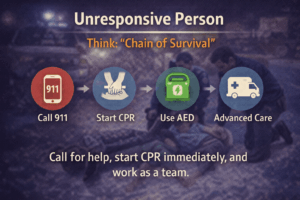
A unique and important concept is the “Chain of Survival”—a series of actions that, when performed quickly and correctly, can improve survival outcomes.
First Aid & Workplace Relevance in Winnipeg, Manitoba
In Winnipeg, Manitoba, emergencies like sudden collapse can happen in workplaces, retail locations, and public spaces across Downtown Winnipeg, St. Vital, and Transcona.
CPR training in Winnipeg and first aid certification in Manitoba are important for:
- Retail and service workers
- Security personnel
- Office and warehouse employees
- Community members
These skills are widely taught in emergency response training across Canada, emphasizing teamwork and early action.
Scenario: Police and Bystanders Respond to Unresponsive Man
 In Abbotsford, British Columbia, police responded to a report of a fight outside a business in the 32900 block of South Fraser Way.
- Officers arrived to find a 54-year-old man unconscious
- They checked for a pulse and began CPR immediately
- Firefighters and paramedics took over upon arrival
Despite efforts:
- The man was transported to hospital
- He was later declared dead
In a related case on Salt Spring Island:
- A 36-year-old man was found unresponsive
- Two bystanders had already started CPR before police arrived
- The officer continued CPR until emergency services took over
These incidents highlight the importance of early CPR and coordinated response, which are key principles taught in Manitoba CPR training programs.
A Unique First Aid Insight: The “Chain of Survival”
The Chain of Survival includes:
- Early recognition and call for help
- Immediate CPR
- Rapid defibrillation (AED)
- Advanced medical care
Why This Matters
- Each step builds on the previous one
- Delays reduce chances of survival
- Bystanders play a crucial role in the first steps
This concept is central to first aid and CPR courses across Canada.
Another Unique Factor: “CPR Handover”
In real emergencies, CPR is often performed by multiple people in sequence.
What is CPR Handover?
- One rescuer starts CPR
- Another takes over when help arrives
- Transitions happen to maintain quality compressions
Why It’s Important
- Prevents fatigue
- Maintains effectiveness
- Ensures continuous care
This is commonly practiced in team-based CPR training in Winnipeg.
Signs Someone Needs CPR
Watch for:
- Unresponsiveness
- No breathing or abnormal breathing
- No detectable pulse
Immediate action is critical.
First Aid Response: What to Do
Based on standard first aid training practices in Canada:
Step 1: Check Responsiveness and Breathing
Step 2: Call Emergency Services Immediately
Step 3: Start CPR
- Begin chest compressions
Step 4: Use an AED (If Available)
- Follow prompts
Step 5: Continue or Rotate Rescuers
- Maintain consistent compressions
Step 6: Continue Until Help Arrives
A Surprising Detail: Teamwork Improves Outcomes
Research and training emphasize that:
- Multiple responders can improve CPR quality
- Clear communication helps coordination
- Even untrained bystanders can assist with simple actions
This teamwork approach is widely taught in Canadian first aid programs.
Prevention and Workplace Considerations
To improve readiness in Winnipeg and across Manitoba:
- Train staff in CPR and AED use
- Encourage quick emergency response
- Ensure AEDs are accessible
- Practice emergency scenarios
Prepared teams can respond more effectively.
Frequently Asked Questions
What is the Chain of Survival?
A sequence of steps that improves survival during cardiac emergencies.
Why is early CPR important?
It helps maintain blood flow to the brain and vital organs.
What is CPR handover?
It is when responders take turns performing CPR to maintain quality.
Can bystanders really make a difference?
Yes, early action before professionals arrive is critical.
Who should learn CPR in Winnipeg?
Everyone can benefit from learning these life-saving skills.
Educational Note
This article is for general awareness and reflects commonly taught CPR practices in Canada. Early recognition and teamwork play an important role in emergency response.
About The Author

Mark Kascha
Certified First Aid Instructor Trainer with 30+ years of real-world experience, including lifeguarding, workplace emergency response, and first aid program development across Canada. Has worked with WorkSafeBC, WSIB, and Manitoba Health.
👉 [View full credentials]🔗 View LinkedIn Profile
Last reviewed: March 2026