Knowing what to do if someone collapses after being hit in the chest or how to respond when a young athlete suddenly goes into cardiac arrest is critical. These rare but serious events require immediate CPR and access to a working AED (automated external defibrillator).
In Winnipeg and across Manitoba, hockey and other sports are a major part of community life. This makes CPR training Winnipeg and AED training Winnipeg especially important for coaches, parents, and arena staff.
First Aid & Workplace Relevance in Canada
Across Canada, sports-related emergencies can happen in:
- Hockey arenas and skating rinks
- School gyms and sports fields
- Community recreation centres
- Organized youth sports leagues
In Winnipeg neighbourhoods like St. Vital and Transcona, where youth sports are active year-round, knowing how to respond to cardiac arrest, chest trauma, and unconsciousness is essential.
Scenario Story: Teen Hockey Player Saved After Collapse
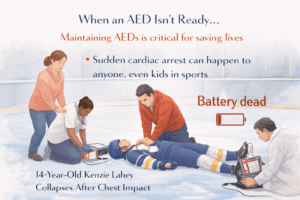 A frightening incident on the ice shows how quickly a life can be at risk.
Kenzie Lahey, a 14-year-old hockey player, was struck in the chest by a puck during a game. Moments later, he grabbed his chest, dropped to his knees, and collapsed on the ice.
At first, many believed he was experiencing a seizure. The referee quickly called for help, and his mother rushed onto the ice. Several bystanders—including an off-duty respiratory therapist and a physician—immediately stepped in to assist.
As they assessed the situation, they recognized that this was more serious. CPR was started right away.
An AED was available at the rink—but it was not functional due to a dead battery.
Fortunately, a nearby ambulance had a working defibrillator. After two shocks were delivered, Kenzie’s heart rhythm was restored. He was stabilized, transported to hospital, and later released after recovery.
His story highlights two critical realities:
quick action saves lives—and equipment readiness matters just as much.
A Unique First Aid Insight: “Commotio Cordis – A Rare but Critical Condition”
A surprising and important concept related to this type of incident is:
➡️ Commotio cordis — a sudden disruption of the heart’s rhythm caused by a direct blow to the chest.
This can occur when:
- An object (like a hockey puck or baseball) strikes the chest
- The impact happens at a very specific moment in the heart’s rhythm
- The person has no underlying heart condition
What makes this unique:
- It can happen to healthy young athletes
- There may be no visible injury
- Survival depends heavily on immediate CPR and rapid defibrillation
This is why AED access in sports facilities across Canada is strongly emphasized.
Symptoms / Warning Signs After Chest Impact
Watch for:
- Sudden collapse after a blow to the chest
- Unresponsiveness
- No normal breathing
- Seizure-like movements (which can be misleading)
- No pulse
These signs indicate a life-threatening emergency requiring immediate action.
Causes / Risk Factors
Factors that may contribute include:
- High-speed projectiles (pucks, balls)
- Direct impact to the chest area
- Youth sports participation
- Lack of immediate AED access
- Delays in recognizing cardiac arrest
Preparedness is key in these environments.
First Aid & CPR Response for Sudden Collapse
Based on standard first aid training practices in Canada, general response includes:
- Calling emergency services immediately
- Checking responsiveness and breathing
- If unresponsive and not breathing normally, CPR may be started
- Using an AED as soon as possible
- Continuing care until emergency responders arrive
These steps are commonly taught in certified CPR and emergency response training across Canada.
Prevention & Workplace Considerations
To improve safety in Manitoba sports and recreation:
- Ensure AEDs are available and regularly maintained
- Train staff, coaches, and volunteers in CPR and AED use
- Perform routine equipment checks (including AED batteries)
- Encourage protective gear where appropriate
- Develop emergency action plans for sporting events
Preparedness includes both training and equipment readiness.
FAQ
What should you do if someone collapses after being hit in the chest?
Call emergency services immediately, check breathing, and begin CPR if needed. Use an AED as soon as possible.
What is commotio cordis?
It is a rare condition where a sudden chest impact disrupts the heart’s rhythm, leading to cardiac arrest.
Why is an AED so important in sports settings?
An AED can restore a normal heart rhythm. Rapid access greatly improves survival chances.
Who should take CPR training in Winnipeg?
Parents, coaches, athletes, and community members can all benefit from training across Manitoba.
How often should AEDs be checked?
AEDs should be checked regularly to ensure batteries and pads are functional and ready for use.
Educational Note
This content is for general awareness and reflects commonly taught practices in first aid and CPR training across Canada. Regular training and equipment checks help individuals respond effectively in real-life emergencies.
About The Author

Mark Kascha
Certified First Aid Instructor Trainer with 30+ years of real-world experience, including lifeguarding, workplace emergency response, and first aid program development across Canada. Has worked with WorkSafeBC, WSIB, and Manitoba Health.
👉 [View full credentials]🔗 View LinkedIn Profile
Last reviewed: March 2026