Understanding Choking and CPR Differences
Choking occurs when an object blocks the airway, preventing normal breathing. Knowing what to do if someone is choking and becomes unresponsive or how CPR changes when the airway is obstructed is critical.
Unlike cardiac arrest from heart-related causes, choking emergencies involve airway blockage first, which changes how CPR is performed.
First Aid & Workplace Relevance in Winnipeg, Manitoba
In Winnipeg, Manitoba, choking incidents can occur at home, in care settings, schools, and workplaces across areas like St. Vital, Transcona, and Downtown Winnipeg.
CPR training in Winnipeg and first aid certification in Manitoba are essential for:
- Caregivers and support workers
- Parents and families
- Teachers and school staff
- Food service and workplace teams
These skills are widely taught in emergency response training across Canada, including choking response and airway management.
Scenario: Family Responds to Choking Emergency
 In Dover, the Keats family acted quickly when a man in their care began choking while eating.
Tony Keats noticed the man was in distress and saw that food—peanut butter on bread—was obstructing his mouth. The individual had a tendency not to chew properly.
- Keats attempted to remove some of the food manually
- He performed abdominal thrusts (Heimlich maneuver)
- The obstruction could not be cleared
Shortly after, the man became unresponsive.
At that point, the family worked together:
- Chest compressions were started
- Rescue breaths were provided
- Emergency services were contacted
Thanks to their coordinated response and prior training, the man was successfully revived.
This situation highlights how teamwork and training—skills emphasized in Manitoba first aid programs—can make a life-saving difference.
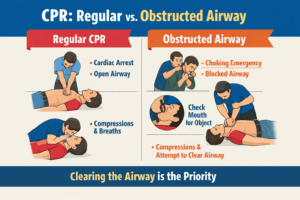
Regular CPR vs CPR for Obstructed Airway
Regular CPR (Cardiac Arrest)
- Cause: Heart stops beating effectively
- Airway: Usually open
- Focus: Circulation (compressions) + breathing
CPR with Obstructed Airway (Choking)
- Cause: Physical blockage in airway
- Airway: Blocked
- Focus: Clearing obstruction while performing CPR
Key Differences in Technique
In Choking Emergencies:
- After the person becomes unresponsive:
- Begin CPR immediately
- Each time you open the airway:
- Look for the object
- Remove it only if clearly visible
- Rescue breaths may be less effective until the airway is cleared
- Chest compressions can help:
- Dislodge the obstruction
- Move air in and out
This approach is commonly taught in certified CPR courses across Canada.
Signs of Severe Choking
Watch for:
- Inability to speak or cough
- Clutching the throat
- Silent attempts to breathe
- Turning pale or blue
- Becoming unresponsive
Immediate action is required.
First Aid Response: What to Do
Based on standard first aid training practices in Canada:
Step 1: Encourage Coughing (if responsive)
Step 2: Perform Abdominal Thrusts
- If choking is severe and not improving
Step 3: If Unresponsive
- Call emergency services
- Begin CPR immediately
Step 4: Check Airway During CPR
- Look for visible obstruction
- Remove only if clearly seen
Step 5: Continue CPR
- Until breathing returns or help arrives
Why Training Makes a Difference
In this case, each family member had a role:
- One performed compressions
- One delivered breaths
- One called emergency services
- One provided direction
This type of coordinated response is often emphasized in first aid training in Winnipeg.
Prevention and Safety Considerations
To reduce choking risks in Winnipeg and across Manitoba:
- Encourage proper chewing and slow eating
- Supervise individuals with swallowing difficulties
- Cut food into manageable sizes
- Promote CPR and choking response training
- Ensure caregivers are trained
Prepared individuals can respond quickly and effectively.
Frequently Asked Questions
What is the difference between choking CPR and regular CPR?
Choking CPR involves checking for and attempting to clear an airway obstruction while performing compressions.
Should you remove the object from the airway?
Only if it is clearly visible. Blind sweeps can push the object further.
Why are compressions used during choking CPR?
They can help dislodge the obstruction and circulate oxygen.
When should CPR be started in choking?
When the person becomes unresponsive and is not breathing normally.
Who should take CPR training in Winnipeg?
Caregivers, parents, and workers can all benefit. Training prepares individuals for real emergencies.
Educational Note
This article is for general awareness and reflects commonly taught first aid and CPR practices in Canada. Early recognition and proper response are key in choking emergencies.
About The Author

Mark Kascha
Certified First Aid Instructor Trainer with 30+ years of real-world experience, including lifeguarding, workplace emergency response, and first aid program development across Canada. Has worked with WorkSafeBC, WSIB, and Manitoba Health.
👉 [View full credentials]🔗 View LinkedIn Profile
Last reviewed: March 2026