Understanding the Emergency: What to Do if Someone Suddenly Collapses
When someone suddenly collapses and becomes unresponsive, it may be due to cardiac arrest, a life-threatening condition where the heart stops pumping effectively. Knowing what to do if someone collapses and stops breathing is critical.
Immediate action—especially CPR and the use of an AED (automated external defibrillator)—can significantly improve survival. These are core skills taught in certified first aid and CPR training programs across Canada.
First Aid & Workplace Relevance in Winnipeg, Manitoba
Although this incident occurred outside Manitoba, similar emergencies can happen in Winnipeg schools, workplaces, and public spaces.
First aid and CPR training is especially important for:
- Teachers and school staff
- Coaches and fitness instructors
- Parents and caregivers
- Workplace supervisors and employees
Across Winnipeg and Manitoba, having CPR training and AED awareness ensures that individuals are prepared to respond quickly during cardiac emergencies—especially in schools where children are active.
Real-Life Scenario: Teacher-Led Rescue Saves Student
 A powerful example of life-saving teamwork occurred when a Grade 6 student, Maryam Basharat, collapsed during gym class just days after the school year began.
It was September 6, and students were outside participating in physical activity when Maryam suddenly collapsed on the grass while running. At first, it appeared she might simply be resting—but it quickly became clear something was seriously wrong.
Teacher Bryan Allen noticed she was gasping for air, a critical warning sign. Recognizing the emergency, he immediately called for help and asked fellow teacher Thomas Guenther to bring the school’s AED.
Within moments, a coordinated response began.
Principal Liana Appelt and staff member Jillian Wright joined the scene. Jillian began CPR while the AED was prepared and applied. A shock was delivered, and shortly after, signs of life began to return.
Emergency services were called immediately, and within approximately four minutes, EMS responder Paul Emmerson arrived. By that time, Maryam’s heart rhythm had been restored, and she was no longer in cardiac arrest.
The teachers’ actions successfully completed the first critical links in the chain of survival—early recognition, CPR, and defibrillation—demonstrating how trained individuals can make a life-saving difference before paramedics arrive.
Symptoms and Warning Signs of Cardiac Arrest
Recognizing cardiac arrest quickly is essential:
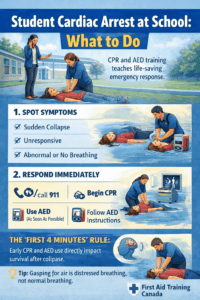
- Sudden collapse
- Unresponsiveness
- Abnormal breathing or gasping (agonal breathing)
- No normal breathing
- No signs of movement
These signs require immediate emergency response.
Causes and Risk Factors
Cardiac arrest in children and adults can be caused by:
- Underlying heart conditions
- Intense physical activity
- Undiagnosed medical issues
- Electrical problems in the heart
While not always predictable, awareness and preparedness are key.
First Aid Response: What Trained Individuals Learn to Do
In CPR and AED training across Canada, responders are taught to:
- Recognize unresponsiveness and abnormal breathing
- Call emergency services immediately
- Begin CPR (chest compressions)
- Use an AED as soon as it is available
- Follow AED prompts and continue care until help arrives
These steps are part of standard life-saving practices taught in Canadian first aid certification programs.
Unique First Aid Insight: The “First 4 Minutes Rule” 💡
A powerful concept taught in training is the importance of the first few minutes after collapse:
- Brain oxygen levels begin to drop quickly without circulation
- CPR helps maintain blood flow to vital organs
- Early AED use can restore a normal heart rhythm
What makes this case remarkable is that trained staff acted within minutes—showing how preparedness in schools and workplaces can directly impact survival.
Another key takeaway:
- Gasping is not normal breathing—it is a sign that immediate CPR may be needed
Prevention and Workplace / School Safety Considerations
Across Winnipeg and Manitoba schools and workplaces, safety measures include:
- Having accessible AEDs on-site
- Ensuring staff are trained in CPR and emergency response
- Practicing emergency action plans
- Supervising physical activity appropriately
- Encouraging widespread CPR training in Winnipeg communities
Prepared environments save lives.
Frequently Asked Questions (FAQ)
What should you do if a child collapses during physical activity?
Check for responsiveness and breathing immediately. If the child is unresponsive and not breathing normally, call emergency services and begin CPR. First aid training teaches how to respond quickly and use an AED if available.
What is gasping and why is it important?
Gasping, or irregular breathing, is not normal and can be a sign of cardiac arrest. It is often mistaken for breathing, but responders are trained to recognize it as a signal to act immediately.
How does an AED help during cardiac arrest?
An AED analyzes the heart’s rhythm and can deliver a shock if needed. It is designed for public use and provides voice instructions, making it accessible for trained responders and bystanders.
Can teachers or non-medical people perform CPR and use an AED?
Yes. CPR and AED use are commonly taught in certified courses across Canada, and lay responders are often the first to act in emergencies.
Why is timing so critical in cardiac arrest situations?
Immediate action helps maintain oxygen flow to the brain and increases the chance of survival. Delays in CPR or AED use can reduce effectiveness, which is why early response is emphasized in training.
Educational Note
This content is for general awareness and reflects commonly taught first aid practices in Canada. It is not a substitute for certified, hands-on CPR and first aid training.
About The Author

Mark Kascha
Certified First Aid Instructor Trainer with 30+ years of real-world experience, including lifeguarding, workplace emergency response, and first aid program development across Canada. Has worked with WorkSafeBC, WSIB, and Manitoba Health.
👉 [View full credentials]🔗 View LinkedIn Profile
Last reviewed: March 2026