Understanding the Emergency: What to Do if Someone Collapses in Public
When someone suddenly collapses in a public place like an airport, it may be due to cardiac arrest, where the heart stops functioning effectively. Knowing what to do if someone stops breathing or becomes unresponsive is critical.
Immediate action—especially CPR and using an AED (automated external defibrillator)—can significantly improve survival. These life-saving steps are widely taught in certified first aid and CPR training programs across Canada.
First Aid & Workplace Relevance in Winnipeg, Manitoba
While this incident occurred in Alberta, similar emergencies can happen in Winnipeg airports, shopping centres, workplaces, and public spaces across Manitoba.
First aid and CPR training is important for:
- Airport and airline staff
- Security personnel and public workers
- Office employees and retail staff
- Travelers and everyday bystanders
Across Winnipeg and Manitoba, having CPR training and AED awareness allows people to respond quickly during cardiac emergencies in busy public environments.
Real-Life Scenario: Airline Crew Saves Passenger at Airport
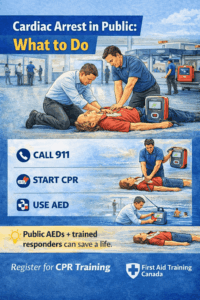 A life-saving response unfolded at Edmonton International Airport when a 73-year-old man, Wayne Gaalaas, collapsed shortly after arriving from a flight.
Wayne had just arrived from Phoenix when he suddenly collapsed in the terminal. Nearby airline crew members immediately recognized the seriousness of the situation.
A crew member from US Airways quickly retrieved a nearby AED, while Guy Fournier, a flight attendant with WestJet, began CPR.
A shock was delivered using the AED, and shortly after, Wayne began to regain responsiveness—an encouraging sign that early intervention was effective.
Emergency services arrived soon after and transported him to a healthcare facility. His family later expressed gratitude for the quick actions of the airline crew, who relied on their training to respond without hesitation.
Airport officials also noted that AEDs had been used multiple times successfully at the airport, reinforcing the importance of accessible life-saving equipment in public spaces.
Symptoms and Warning Signs of Cardiac Arrest
Recognizing cardiac arrest quickly is essential:
- Sudden collapse
- Unresponsiveness
- No normal breathing or gasping
- No signs of movement
These signs require immediate emergency response.
Causes and Risk Factors
Cardiac arrest can occur due to:
- Underlying heart conditions
- Age-related cardiovascular risks
- Physical stress or exertion
- Undiagnosed medical issues
Preparedness is key, especially in public settings.
First Aid Response: What Trained Individuals Learn to Do
In CPR and AED training across Canada, responders are taught to:
- Check for responsiveness and breathing
- Call emergency services immediately
- Begin CPR (chest compressions)
- Retrieve and use an AED as soon as possible
- Follow AED prompts and continue care until help arrives
These are standard life-saving practices taught in Canadian first aid certification programs.
Unique First Aid Insight: The “Public Access AED Advantage” 💡
One of the most powerful developments in emergency response is the availability of AEDs in public spaces:
- AEDs are designed for use by everyday people—not just professionals
- They provide clear voice instructions step-by-step
- Early defibrillation can significantly improve survival chances
What makes this case remarkable is how quickly trained staff located and used an AED—demonstrating how public access to life-saving tools combined with training can change outcomes.
Another key takeaway:
- Confidence comes from training—responders often act faster when they recognize the situation immediately
Prevention and Workplace / Public Safety Considerations
Across Winnipeg and Manitoba, improving safety in public spaces includes:
- Installing AEDs in high-traffic areas
- Training staff in CPR and AED use
- Promoting awareness of emergency response procedures
- Encouraging the public to take CPR training in Winnipeg
- Maintaining clear access to emergency equipment
Prepared environments save lives.
Frequently Asked Questions (FAQ)
What should you do if someone collapses in an airport or public place?
Check for responsiveness and breathing, call emergency services, and begin CPR if needed. If an AED is available, use it as soon as possible. First aid training teaches how to act quickly and confidently.
Can untrained people use an AED?
Yes. AEDs are designed to guide users with voice prompts. Training helps build confidence, but the device itself is made for public use.
Why is CPR important before paramedics arrive?
CPR helps maintain blood flow to the brain and vital organs. Early action can improve survival chances significantly.
How do public AEDs improve survival rates?
Having AEDs nearby allows faster response times. Early defibrillation can restore a normal heart rhythm more quickly than waiting for emergency services alone.
Who should learn CPR and AED use?
Anyone can benefit—especially those working in public spaces, workplaces, or caring for others. Training prepares individuals to respond in real emergencies.
Educational Note
This content is for general awareness and reflects commonly taught first aid practices in Canada. It is not a substitute for certified, hands-on CPR and first aid training.
About The Author

Mark Kascha
Certified First Aid Instructor Trainer with 30+ years of real-world experience, including lifeguarding, workplace emergency response, and first aid program development across Canada. Has worked with WorkSafeBC, WSIB, and Manitoba Health.
👉 [View full credentials]🔗 View LinkedIn Profile
Last reviewed: March 2026