Knowing what to do if someone is having a heart attack or how to respond when a person suddenly collapses from cardiac arrest can make the difference between life and death. Quick action—especially calling for help and starting CPR—can help maintain circulation until emergency responders arrive.
In Winnipeg and across Manitoba, heart-related emergencies can occur at home, at work, or in public places. This is why CPR training Winnipeg and first aid certification Manitoba are essential for families, coworkers, and community members.
First Aid & Workplace Relevance in Canada
Across Canada, heart attack awareness and CPR skills are important for:
- Workplace first aid attendants
- Family members and caregivers
- Fitness centres and public venues
- Anyone in community settings
In Winnipeg neighbourhoods like St. Vital and Downtown, where people gather in homes and public spaces, early recognition of chest pain and cardiac arrest can help save lives.
Scenario Story: 10 Minutes Without a Pulse—Saved by CPR and AED
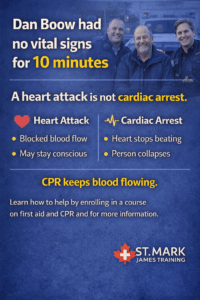 A remarkable case involving Dan Boow shows how fast action can change an outcome.
While at home watching TV with his partner, Sherry Polkosnik, Boow began experiencing a heavy sensation in his chest. Recognizing something was wrong, he asked her to call for emergency assistance.
Paramedics from Essex-Windsor EMS responded quickly. Initially conscious, Boow was being assisted when he suddenly collapsed and lost his pulse.
Emergency responders immediately began CPR to keep blood circulating. A defibrillator was used to deliver shocks in an effort to restore his heart rhythm.
For approximately 8–10 minutes, Boow had no vital signs.
Despite this, paramedics continued their efforts. He was transported to a healthcare facility, where he later regained consciousness and recovered.
A month later, he reunited with the paramedics who helped save his life—highlighting how rapid response, CPR, and AED use can lead to survival even in critical situations.
A Unique First Aid Insight: “Heart Attacks and Cardiac Arrest Are Not the Same”
One surprising and important fact is:
➡️ A heart attack and cardiac arrest are different—but one can lead to the other.
- Heart attack: Blood flow to the heart is blocked (person may still be conscious)
- Cardiac arrest: The heart stops pumping effectively (person becomes unresponsive)
Another lesser-known insight:
➡️ Many heart attacks begin with mild symptoms that people ignore—like pressure, discomfort, or fatigue—not just sudden collapse.
And even more surprising:
➡️ CPR does not restart the heart—it helps keep blood flowing until a defibrillator or advanced care can restore rhythm.
These concepts are commonly taught in certified CPR courses across Canada.
Symptoms / Warning Signs of a Heart Attack
Watch for:
- Chest pressure, tightness, or discomfort
- Pain spreading to arms, neck, or jaw
- Shortness of breath
- Nausea or lightheadedness
- Sudden fatigue
If the person collapses, it may indicate cardiac arrest.
Causes / Risk Factors
Heart attacks may be linked to:
- Coronary artery disease
- High blood pressure
- Lifestyle factors
- Age-related conditions
However, they can occur unexpectedly—even in everyday settings.
First Aid & CPR Response
Based on standard first aid training practices in Canada, general response includes:
- Calling emergency services immediately
- Keeping the person calm and at rest if conscious
- Monitoring breathing and responsiveness
- If the person becomes unresponsive and not breathing normally, starting CPR
- Using an AED as soon as available
- Continuing care until emergency responders arrive
These skills are commonly taught in certified CPR and AED training across Canada.
Prevention & Workplace Considerations
To improve safety in Manitoba:
- Encourage CPR and AED training in workplaces
- Promote awareness of early heart attack symptoms
- Ensure AEDs are accessible and maintained
- Support regular recertification training
- Encourage quick action when symptoms appear
Preparedness can improve outcomes.
FAQ
What should you do if someone has chest pain?
Call emergency services immediately and monitor the person closely.
Can someone survive after several minutes without a pulse?
Survival is possible with rapid CPR and AED use, as shown in this case.
What is the difference between a heart attack and cardiac arrest?
A heart attack involves blocked blood flow, while cardiac arrest involves the heart stopping.
Why is CPR important during cardiac arrest?
CPR helps maintain blood flow to the brain and vital organs.
Who should take CPR training in Winnipeg?
Everyone—from workers to families—can benefit from training.
Educational Note
This content is for general awareness and reflects commonly taught practices in CPR and first aid training across Canada. Early recognition and response can improve outcomes in cardiac emergencies.
About The Author

Mark Kascha
Certified First Aid Instructor Trainer with 30+ years of real-world experience, including lifeguarding, workplace emergency response, and first aid program development across Canada. Has worked with WorkSafeBC, WSIB, and Manitoba Health.
👉 [View full credentials]🔗 View LinkedIn Profile
Last reviewed: March 2026