Understanding Mass Casualty Incidents and Emergency Response
Mass casualty incidents, such as vehicle-related attacks, can result in multiple injuries occurring at once. Knowing what to do if multiple people are injured and how to respond when someone is unresponsive is critical. In Canada, first aid and CPR training emphasize scene safety, prioritizing care, and assisting until emergency services arrive.
First Aid & Workplace Relevance in Winnipeg, Manitoba
 While this incident occurred in Toronto, similar emergency preparedness is important across Winnipeg, Manitoba, including busy public areas like Downtown Winnipeg, St. Vital, and Transcona.
CPR training in Winnipeg and first aid certification are essential for:
-
Public-facing workers and event staff
-
Security personnel and supervisors
-
Teachers and community leaders
-
General public and bystanders
These skills are widely taught in first aid certification programs in Manitoba and support safer communities.
Scenario: Emergency Response During Toronto Van Attack
A tragic mass casualty incident unfolded in Toronto when a van was driven onto a crowded sidewalk along Yonge Street, between Finch Avenue and Sheppard Avenue.
During the chaos, multiple police officers and first responders quickly moved into action. According to Mike McCormack of the Toronto Police Association, one officer’s actions during the arrest of the suspect stood out as a moment of professionalism and restraint during a highly dangerous situation.
As the event unfolded, officers worked to protect the public by directing pedestrians away from danger and clearing the area. At the same time, other officers began assisting injured individuals.
First responders provided immediate care at the scene, including performing CPR on victims and addressing injuries until paramedics could take over. Their rapid response helped support those affected during a critical time.
The incident resulted in multiple fatalities and injuries, leaving a significant impact on the community. Despite the scale of the emergency, the coordinated efforts of first responders demonstrated the importance of training, quick decision-making, and preparedness.
Symptoms and Warning Signs of Critical Injury
In large-scale emergencies, individuals may present with:
-
Unresponsiveness or unconsciousness
-
Difficulty breathing or no breathing
-
Visible injuries or bleeding
-
Confusion or disorientation
-
Signs of shock (pale skin, rapid pulse)
Recognizing these signs helps guide immediate care priorities.
Causes and Risk Factors
Mass casualty incidents may involve:
-
Vehicle-related impacts in public spaces
-
Unexpected acts of violence
-
High-density pedestrian areas
These events are unpredictable and require coordinated response.
First Aid Response: Prioritizing Care and CPR
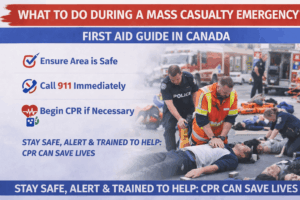
In Canada, first aid training emphasizes:
-
Ensure your own safety and be aware of surroundings
-
Call 911 immediately
-
Assist those who are most seriously injured if it is safe
If someone is unresponsive and not breathing:
-
Begin CPR immediately
-
Continue until emergency responders arrive
These steps are based on standard first aid training practices in Canada and are commonly taught in certified CPR courses.
Prevention and Workplace Safety Considerations
Preparedness can improve outcomes:
-
Encourage emergency response training in Canada
-
Develop emergency action plans for public spaces
-
Train staff in CPR and first aid
-
Promote situational awareness in crowded environments
In Winnipeg and across Manitoba, planning and training help increase safety in public settings.
Frequently Asked Questions
What should you do in a mass casualty emergency?
Ensure your safety first, call emergency services, and assist others only if it is safe. Focus on those who need immediate help.
Can CPR help in large-scale emergencies?
Yes, CPR can help individuals who are not breathing by maintaining circulation until paramedics arrive.
Is it safe for bystanders to help?
Only if the area is secure. Your safety should always come first before assisting others.
Who should take CPR training in Winnipeg?
Anyone can benefit, especially those working in public environments. Many workplaces in Manitoba encourage certification.
Why is emergency training important in public spaces?
Training helps individuals respond quickly and effectively, which can improve outcomes during unexpected events.
Educational Note
This article is for general awareness and reflects commonly taught first aid and CPR practices in Canada. Training helps individuals respond confidently and safely during emergencies.
About The Author

Mark Kascha
Certified First Aid Instructor Trainer with 30+ years of real-world experience, including lifeguarding, workplace emergency response, and first aid program development across Canada. Has worked with WorkSafeBC, WSIB, and Manitoba Health.
👉 [View full credentials]🔗 View LinkedIn Profile
Last reviewed: March 2026