Understanding Cardiac Arrest in School Settings
Cardiac arrest can happen suddenly—even in young, healthy individuals. Knowing what to do if a student collapses and stops breathing or how to respond using CPR and an AED in a school setting is critical.
In cardiac arrest, the heart stops pumping effectively, and without immediate action, survival chances decrease quickly.
First Aid & Workplace Relevance in Winnipeg, Manitoba
 In Winnipeg, Manitoba, schools, gyms, and recreation facilities in areas like St. Vital, Transcona, and Downtown Winnipeg regularly host large numbers of students and staff.
CPR training in Winnipeg, AED training in Canada, and first aid certification in Manitoba are essential for:
- Teachers and school staff
- Coaches and physical education instructors
- School administrators and support staff
- Students and community volunteers
These skills are widely taught in emergency response training across Canada, helping ensure rapid response in school environments.
Scenario: Student Saved by Teachers Using CPR and AED
At Southern Okanagan Secondary School in Oliver, British Columbia, a Grade 8 student named Dilshaan Dhaliwal suddenly collapsed in the gym.
Two teachers, Steve Podmorrow and Mike Russo, were nearby and immediately responded:
- They assessed the situation and began CPR
- They quickly retrieved and used the school’s AED (Automated External Defibrillator)
The student had shown no warning signs prior to collapsing, making the situation unexpected and urgent.
Dhaliwal was transported to Okanagan General Hospital and later to BC Children’s Hospital, where he received further care. He later recovered and was discharged within a week.
Medical professionals confirmed that early CPR and AED use were critical in saving his life. The student was later identified as having a congenital heart condition, which had not previously caused noticeable symptoms.
This incident highlights the importance of preparedness in schools across Manitoba and Canada.
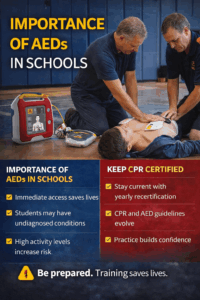
Why AEDs Are Critical in Schools
Immediate Access Saves Lives
- Cardiac arrest survival decreases by about 10% per minute without intervention
- AEDs can restore a normal heart rhythm quickly
- Schools are high-traffic environments where rapid response is essential
School-Specific Benefits
- Students may have unknown or undiagnosed conditions
- Physical activity (e.g., gym class) can trigger cardiac events
- Staff are often the first responders before paramedics arrive
Having accessible AEDs in schools is strongly supported by first aid and safety programs across Canada.
Importance of Keeping CPR Certification Current
CPR guidelines evolve based on research. Keeping certification current ensures:
- You are using correct compression techniques and timing
- You understand updated AED procedures
- You can respond confidently in high-stress situations
- You stay aligned with current Canadian first aid standards
Recertification Matters
- Many certifications require renewal every 1–3 years
- Some workplaces and schools encourage annual refreshers
- Regular practice improves speed, accuracy, and confidence
This is especially important in schools, where immediate response can make a critical difference.
Symptoms and Warning Signs of Cardiac Arrest
Watch for:
- Sudden collapse
- No breathing or abnormal breathing
- Unresponsiveness
- No pulse
Immediate action is critical.
First Aid Response: What to Do
Based on standard first aid training practices in Canada:
- Call emergency services immediately
- Check responsiveness and breathing
- Begin CPR (chest compressions)
- Retrieve and apply an AED as soon as possible
- Follow AED prompts
- Continue CPR until help arrives
Early CPR and AED use are key to survival.
Prevention and School Safety Considerations
To improve safety in Winnipeg and across Manitoba:
- Ensure AEDs are clearly marked and accessible in schools
- Train staff regularly in CPR and AED use in Winnipeg
- Conduct emergency drills in gymnasiums and classrooms
- Encourage CPR education for students
- Maintain AED equipment (battery and pads)
Prepared schools create safer learning environments.
Frequently Asked Questions
Why are AEDs important in schools?
AEDs allow for immediate response to cardiac arrest, which is critical since delays can reduce survival chances significantly.
How often should CPR certification be renewed in Canada?
Most certifications are valid for 1 to 3 years, but regular refreshers are encouraged to maintain confidence and skill accuracy.
Can children experience cardiac arrest without warning?
Yes, some children may have underlying conditions that are not immediately noticeable. This is why preparedness is important.
Are AEDs safe to use on students?
Yes, AEDs are designed to be safe and provide instructions. They are commonly used in schools across Canada.
Who should learn CPR in Winnipeg schools?
Teachers, staff, coaches, and even students can benefit. Training helps ensure a quick and effective response.
Educational Note
This article is for general awareness and reflects commonly taught first aid and CPR practices in Canada. Early CPR, AED access, and ongoing training are essential in school emergency response.
About The Author

Mark Kascha
Certified First Aid Instructor Trainer with 30+ years of real-world experience, including lifeguarding, workplace emergency response, and first aid program development across Canada. Has worked with WorkSafeBC, WSIB, and Manitoba Health.
👉 [View full credentials]🔗 View LinkedIn Profile
Last reviewed: March 2026