Understanding the Gap in CPR Response
 Cardiopulmonary resuscitation (CPR) is a life-saving technique used when a person’s heart stops beating. Immediate chest compressions can help maintain blood flow to vital organs until emergency services arrive.
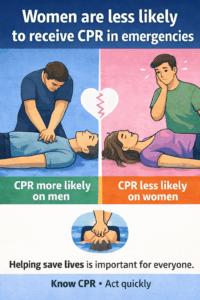
However, studies have shown that in public settings, women are less likely to receive bystander CPR compared to men. This gap is often linked to hesitation, uncertainty, or misconceptions about performing CPR on a female victim.
In Canada, including Winnipeg and across Manitoba, improving CPR awareness and confidence is an important part of public health and workplace safety education.
First Aid & Workplace Relevance in Canada
Cardiac arrest can occur anywhere—offices, public spaces, gyms, or job sites. In workplaces throughout Winnipeg and surrounding communities, first aid training helps ensure that employees are prepared to respond appropriately, regardless of the individual affected.
Understanding that CPR techniques are the same for all adults can help reduce hesitation and improve response times in emergencies.
A Realistic Scenario: Public Emergency Response
In a busy public setting, a woman suddenly collapses and becomes unresponsive. People nearby recognize that something is wrong but hesitate to step in.
One bystander recalls their CPR training and understands that immediate action is important. They check for breathing and begin chest compressions while another person calls 911. The situation becomes more organized as others assist until emergency services arrive.
This scenario reflects how awareness and training can help overcome uncertainty and support timely action.
Why Hesitation Happens
Research and surveys have identified several reasons why bystanders may hesitate to perform CPR on women:
-
Concern about causing physical harm
-
Uncertainty about proper hand placement
-
Fear of inappropriate contact or social misunderstanding
-
Lack of confidence in CPR skills
These concerns can delay response, even though CPR techniques are designed to be safe and effective when performed correctly.
Understanding Proper CPR Technique
CPR for adults is performed the same way regardless of sex:
-
Hands are placed on the centre of the chest (sternum)
-
Compressions are delivered straight down on the breastbone
-
The goal is to keep blood circulating until help arrives
Training programs in Canada emphasize correct hand placement and technique to ensure clarity and confidence for responders.
When to Take Action
If someone collapses and is not breathing normally:
-
Call 911 immediately or ask someone nearby to call
-
Begin chest compressions in the centre of the chest
-
Continue until emergency services arrive or the person shows signs of recovery
Early CPR can significantly improve outcomes during cardiac arrest.
Importance of Equal Response
Heart-related emergencies affect both women and men. Providing immediate CPR—regardless of the person’s sex—is essential in supporting survival.
Public education, workplace training, and awareness campaigns across Canada continue to emphasize the importance of acting quickly and confidently in all cardiac emergencies.
Frequently Asked Questions
Is CPR performed differently on women?
No, CPR technique for adults is the same regardless of sex, focusing on compressions over the breastbone.
Why are women less likely to receive CPR?
Some bystanders report hesitation due to uncertainty, lack of confidence, or social concerns.
Can chest compressions cause harm?
Compressions are designed to support circulation during cardiac arrest. The priority is maintaining blood flow in an emergency.
Where should hands be placed during CPR?
Hands are placed in the centre of the chest on the sternum, not on surrounding tissue.
How can people feel more confident performing CPR?
Participating in CPR and first aid training helps build confidence and understanding of proper techniques.
Educational Note
This article is for general awareness and education. First aid and CPR training can help individuals respond more confidently and effectively in emergency situations.
About The Author

Mark Kascha
Certified First Aid Instructor Trainer with 30+ years of real-world experience, including lifeguarding, workplace emergency response, and first aid program development across Canada. Has worked with WorkSafeBC, WSIB, and Manitoba Health.
👉 [View full credentials]🔗 View LinkedIn Profile
Last reviewed: March 2026